
Dallas Criminal History Checks
Start with the office that created the event. Dallas Police holds city incident and accident reports. Dallas Municipal Court holds city ordinance, traffic, and misdemeanor court records. The Paulding County jail holds the booking entry after a custodial arrest, while Superior or State Court holds a later county prosecution. Georgia’s state repository may then receive the arrest cycle and disposition.
- Confirm that the event occurred inside Dallas city limits and identify the arresting agency.
- Ask Dallas Police for an incident or accident report through the correct requester channel.
- Contact Dallas Municipal Court for a city citation, misdemeanor, traffic case, or bench-warrant entry.
- Use Paulding County booking and court channels when the arrest or charge moved to county custody or prosecution.
- Use an official Georgia criminal-history product only when the question calls for statewide information.
This order prevents a common mismatch. A Dallas mailing address can describe a place outside the city’s police jurisdiction. The agency name on the citation or report is more useful than the postal city.
Dallas Police Reports on Main Street
The Dallas Police Department is at 120 Main Street, Dallas, Georgia 30132. Its main number is 770-443-8100 and fax is 770-443-8106. The city separates requesters by their relationship to an incident. An involved party may receive an incident report free. An uninvolved requester uses the city’s open-records process, where active investigations, pending prosecutions, and juvenile material may be withheld.
Dallas Police Department
120 Main Street
Dallas, GA 30132
770-443-8100
Police reports and city incident records
The official department page shows the city office used for Dallas police records.
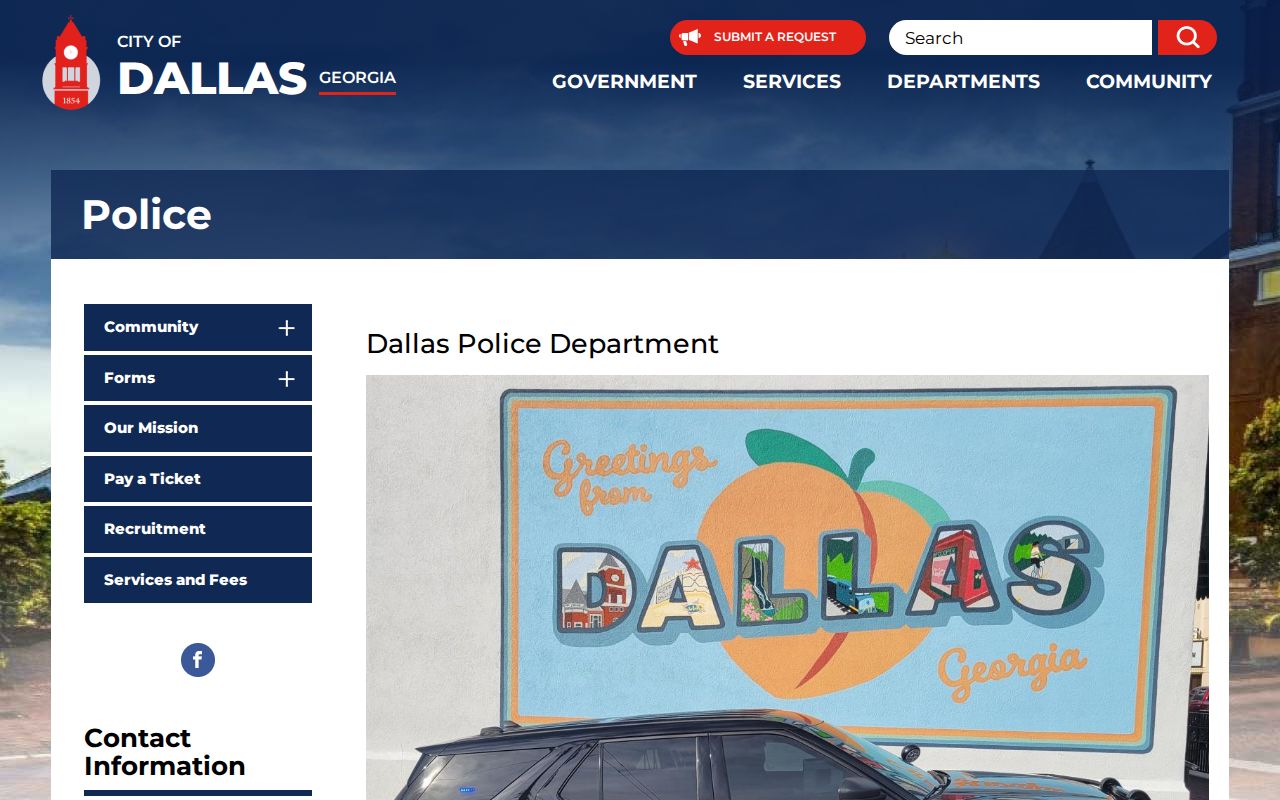
This city counter is distinct from the Paulding County Sheriff’s records office on Constitution Boulevard.
Records at the Dallas Police Department
The city’s police services and fee schedule distinguishes incident, accident, background-check, notary, certified-copy, and media services. Accident reports may route through BuyCrash. If no officer made the crash report, the city points to Georgia Form SR-13 instead. A payment link or vendor page does not function as a complete Dallas criminal case search.
Counter service fees are cash only. The listed city amounts are $10 for a background check for a Paulding resident, $20 for a nonresident, $2 per notary service up to $4 per person, $5 per certified copy, and $10 for a DVD or CD. These police service charges are not the same as open-record production costs.
| Dallas record | Primary channel | Cost note |
|---|---|---|
| Incident report, involved party | Dallas Police | Free |
| Incident report, uninvolved requester | NextRequest | Production charges may apply |
| Officer crash report | BuyCrash link from police page | Vendor cost not stated by city |
| No-officer crash report | Georgia SR-13 | Self-report route |
| Certified copy | Police counter | $5 each, cash only |
The city’s official services page displays the local report rules and charges.
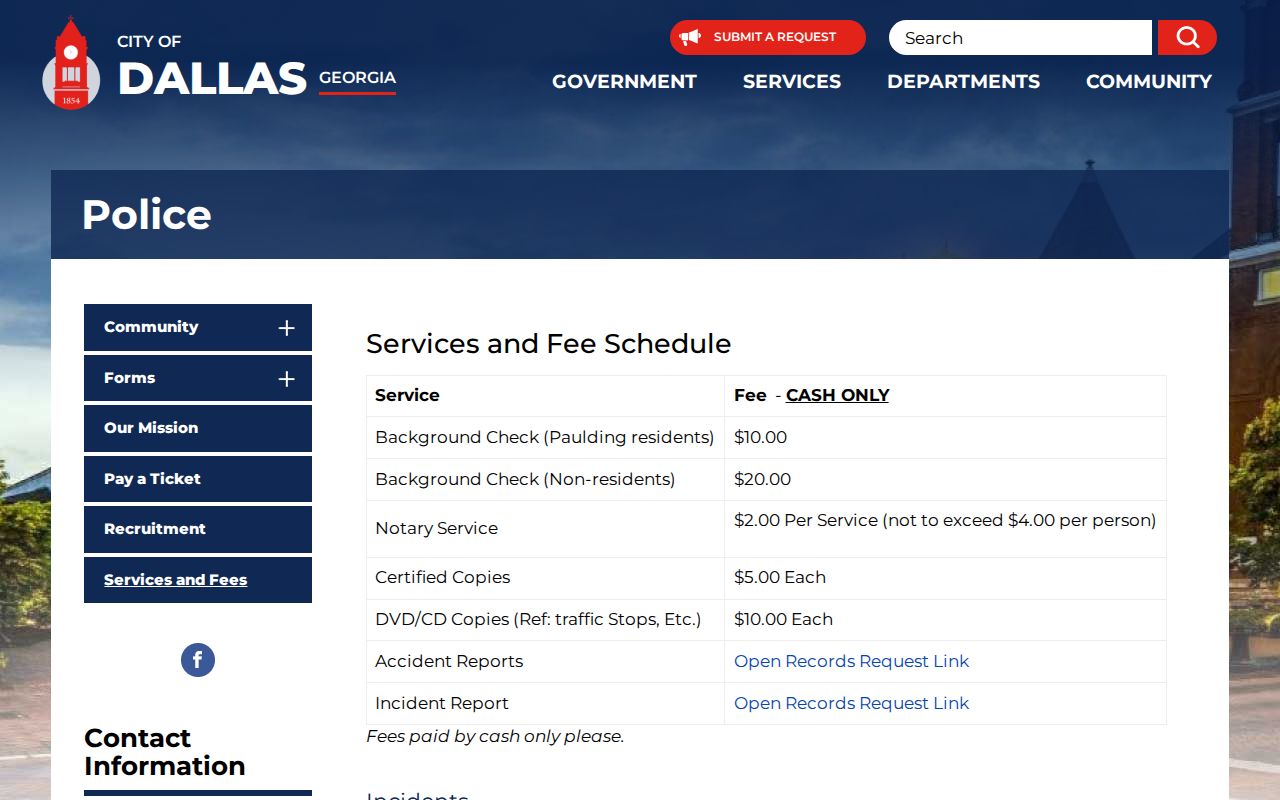
Its categories help a requester choose a police service instead of sending an unfocused citywide request.
Dallas Crash Record Channels
A Dallas traffic event does not always produce the same document. When a Dallas officer completed the crash report, the police services page points to BuyCrash. When no officer made a report, the city points the driver to Georgia Form SR-13. A related citation can also create a Municipal Court file, while an injury investigation may create a separate police incident record.
Begin with the kind of document, not the broad phrase “accident record.” Use BuyCrash for the officer report, SR-13 for the no-officer reporting path, and Court Services for a citation’s docket and outcome. NextRequest remains the city route for a specifically described releasable police record when direct channels do not answer the request.
Dallas NextRequest Routes Police Files
Uninvolved requesters can use the city’s open-records instructions and select Police Department in NextRequest. The portal accepts accident and incident report requests. Give a clear description, useful keywords, and a narrow date range. Avoid placing an unnecessary Social Security number or other sensitive identifier into a request that may itself become public.
| Portal control | Purpose | Requirement |
|---|---|---|
| Name and contact | Tracks the requester and response | Portal indicated |
| Department | Select Police Department for police records | Yes for routing |
| Description | State the record, keywords, and date range | Yes |
| Date range or attachment | Narrows or supports the request | Optional |
| Legal acknowledgement | Accepts cost terms and certifies submission | Yes |
| Submit and track | Manages correspondence | Portal workflow |
The city describes the public request route on its official instructions page.
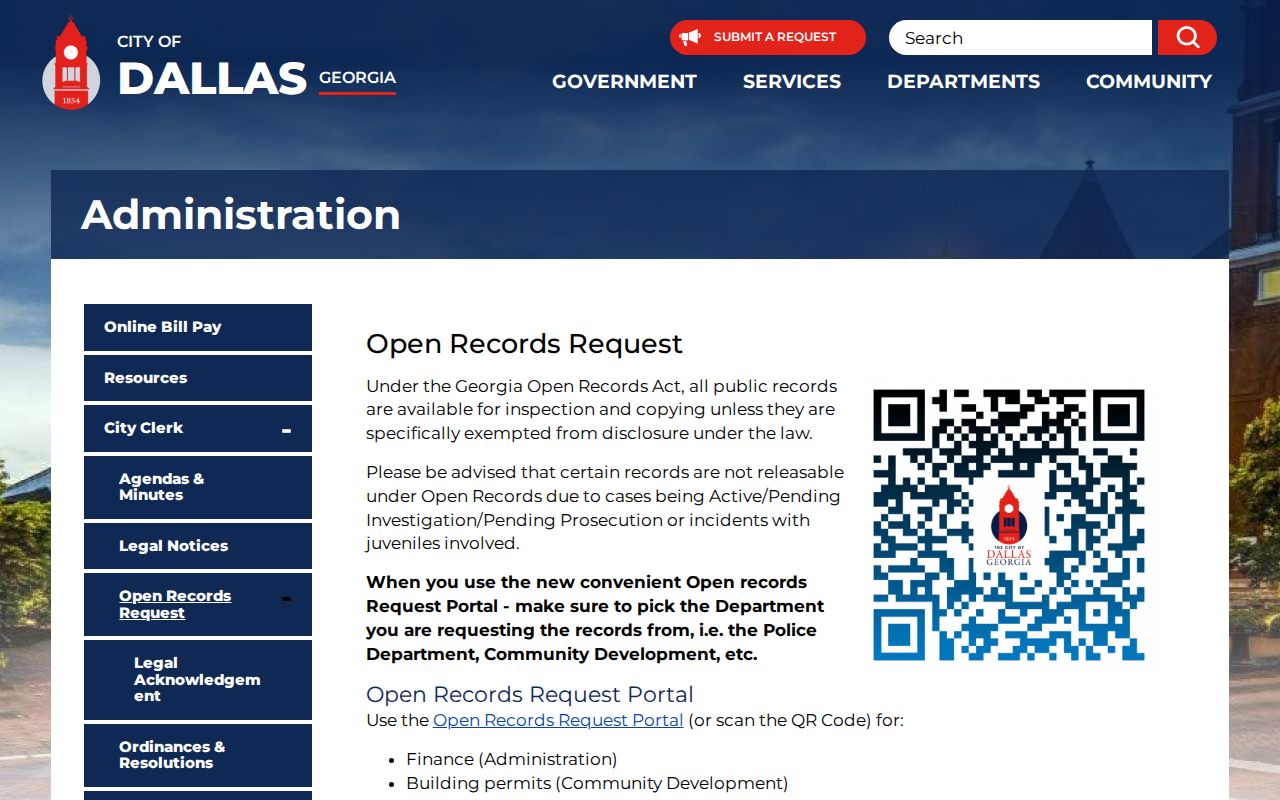
The page keeps city police requests separate from direct county sheriff and court requests.
The Dallas NextRequest portal is the city’s named submission and tracking system.
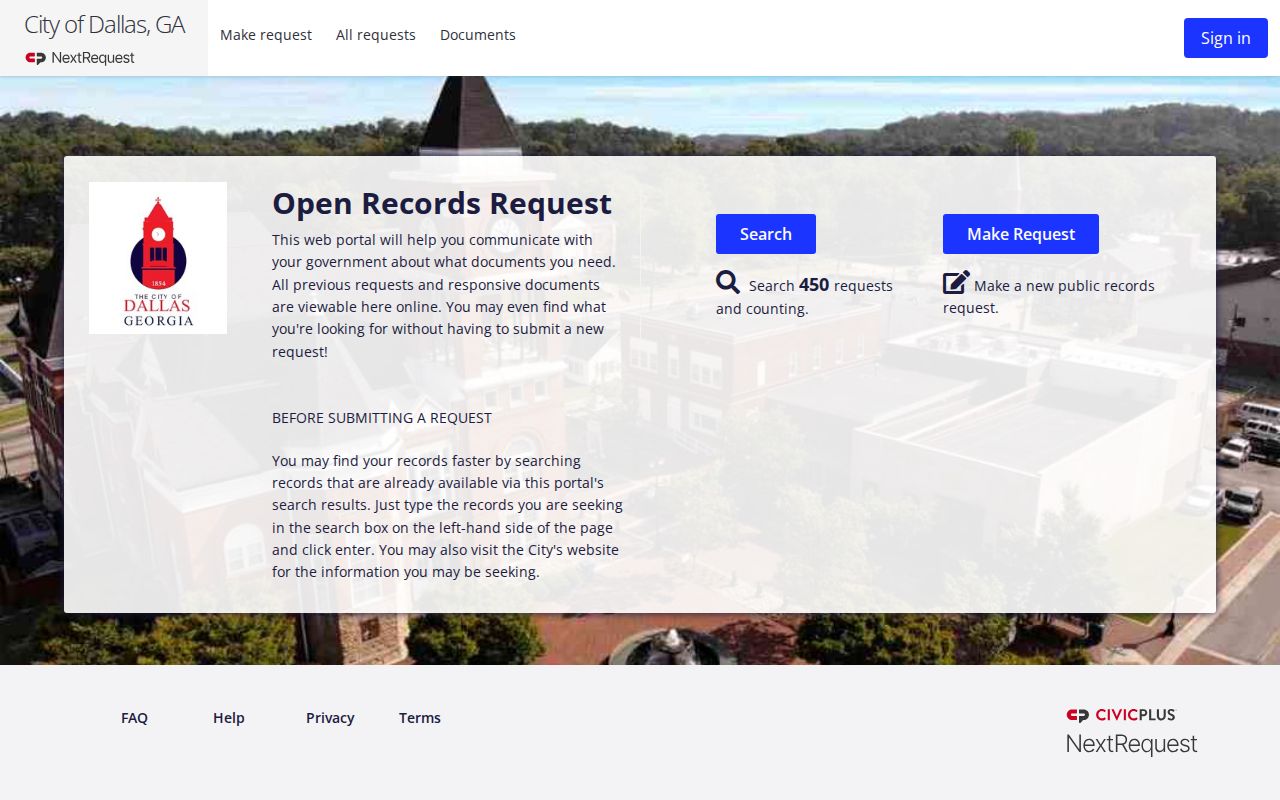
Selecting the right department and using specific dates gives city staff a workable request.
Booking and Arrest Records in Dallas
Dallas Police does not advertise a long-term city jail or a public city inmate roster. Custodial arrests are traced through the Paulding County Sheriff’s Online Offender Lookup and the Paulding County Detention Center. A current jail result answers a custody question, not the final outcome of the accusation. A person’s absence can mean release rather than no prior arrest.
Request the original city incident report from Dallas Police. Check the county booking record for intake and custody details. Then contact Dallas Municipal Court for a municipal matter, or the appropriate Paulding court for a county charge. More detail on the custody path belongs in the Paulding County arrest search.
Why Dallas Records May Differ
A single event can create three records on different schedules. The police report documents the city agency’s incident and investigation. The jail record documents booking and custody. The court file documents filed charges, pleas, motions, disposition, and sentence. Prosecutors may change or decline charges after an arrest, so the labels need not match.
- Incident report
- The Dallas Police record of the reported event and agency response.
- Booking entry
- The Paulding jail intake record, including allegations and custody fields.
- Disposition
- The court’s recorded outcome for a charge; it may be conviction, dismissal, acquittal, or another result.
- OTN
- The Offender Tracking Number used to connect an arrest cycle with prosecution and disposition reporting.
Follow the record forward instead of assuming the first entry tells the whole story. A city arrest date, county booking date, and later court filing date may all be valid.
The Dallas Municipal Court File
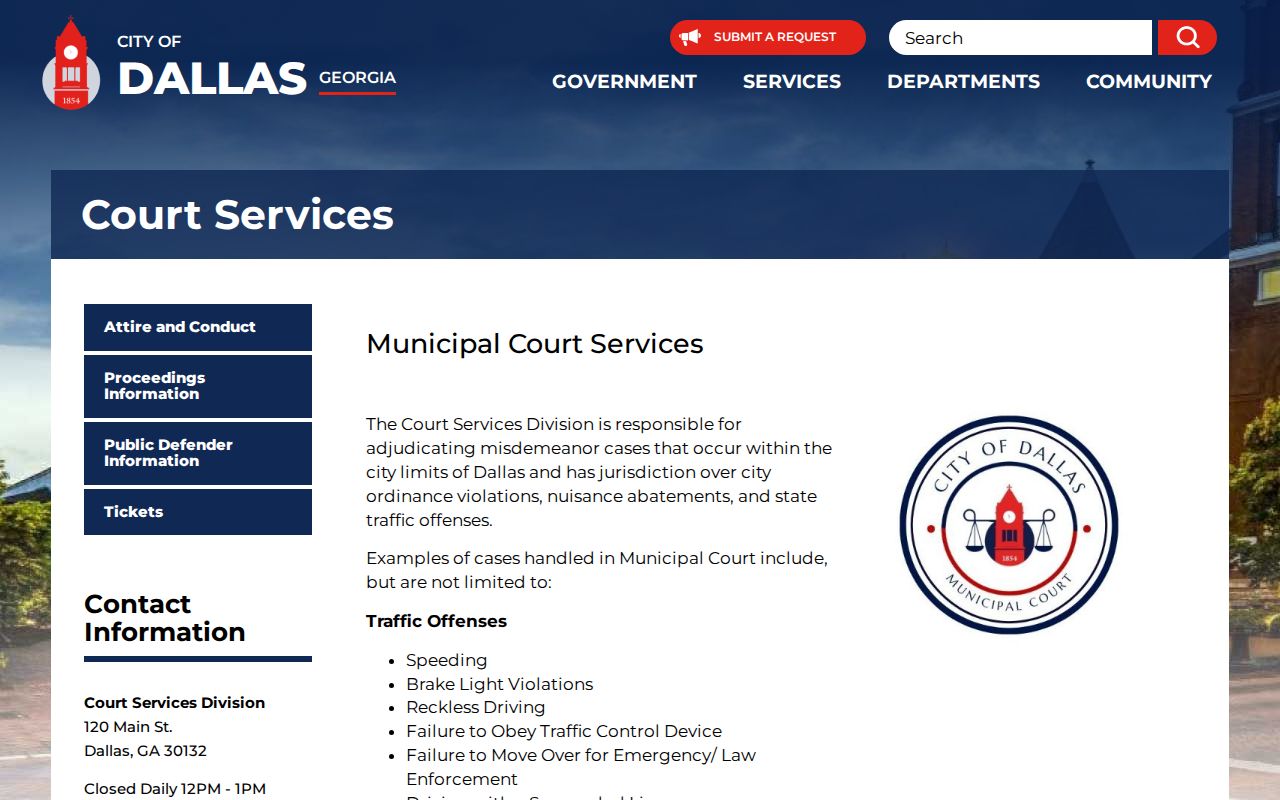
Dallas Court Services operates at 120 Main Street. The office is open Monday through Friday from 8:00 a.m. to 5:00 p.m., with a noon to 1:00 p.m. closure. Call 770-443-8100 extension 3. The court handles city ordinance matters, state traffic offenses, nuisance abatements, and misdemeanors arising inside Dallas.
Examples include speeding, reckless driving, suspended-license and no-insurance cases, DUI, misdemeanor shoplifting, criminal trespass, underage alcohol consumption, and local animal or junk-vehicle ordinances. No complete public city docket search was found. Call or visit Court Services for case status. “Pay a Ticket” is a payment channel, not proof of a complete case search.
| Court | Dallas Municipal Court, 120 Main Street |
|---|---|
| Case types | City ordinances, traffic, nuisance matters, and city misdemeanors |
| Lookup | Clerk phone or counter; records may also be requested through NextRequest |
| File contents | Citation or charge, hearing entries, plea, disposition, sentence, and financial entries where applicable |
| Hours | Monday-Friday, 8:00 a.m.-5:00 p.m.; closed noon-1:00 p.m. |
The official Court Services page shows the city court’s scope and contact channel.
Municipal records should stay at city altitude unless the charge moves into a Paulding County court.
After Missing Dallas Municipal Court
A missed Dallas court date can produce a bench warrant and added case costs. The official 2024 schedule lists a $200 bench-warrant fee for failure to appear. It also lists a $49 monthly city probation fee, a 3.5 percent credit or debit traffic-fine fee, and a $150 standard basic traffic violation. The amount in a real case can differ.
Contact Court Services for the case status and the proper way to address the missed appearance. Do not rely on a payment screen alone, and do not assume a countywide name search will expose a city bench warrant. Resolve one’s own warrant through the issuing court or counsel.
How Dallas Records Reach the County
Dallas Police begins the local file. A custodial arrest moves to the Paulding County jail. A city-level matter stays in Municipal Court, while charges outside that court’s scope may be filed in Paulding Superior or State Court. The clerk then reports applicable disposition data into Georgia’s criminal-history structure.
Record flow: Dallas Police Department › Dallas Municipal Court or Paulding County Courts › Georgia Bureau of Investigation / Georgia Crime Information Center
City Court also forwards applicable entries to the Georgia Department of Driver Services. That is why the Dallas municipal docket can matter even when the same event has a county booking entry. For the later charging and disposition file, use the Paulding County court case lookup.
Dallas Addresses Can Misroute Searches
Dallas is the county seat and contains both city offices and much of the Paulding justice campus. It had an official July 1, 2025 population estimate of 15,402. Yet a “Dallas” postal address can sit in unincorporated Paulding County, outside Dallas Police jurisdiction. That distinction determines who holds the original incident report.
Read the agency name on the citation, report, or booking entry. Send a Dallas Police event to the city. Send a sheriff event to Paulding County. The dense mix of agencies around Dallas makes location alone a weak routing tool.
Dallas Record Access Rules
The Georgia Open Records Act, O.C.G.A. §§50-18-70 through 50-18-77, governs access to releasable city records. Dallas may charge $0.10 per page and the lowest qualified employee’s hourly wage after the first 15 minutes of search and retrieval. An estimate above $500 may require prepayment. Charges may still apply when prepared records are not picked up.
The city’s open-records legal acknowledgement states those cost and specificity terms.
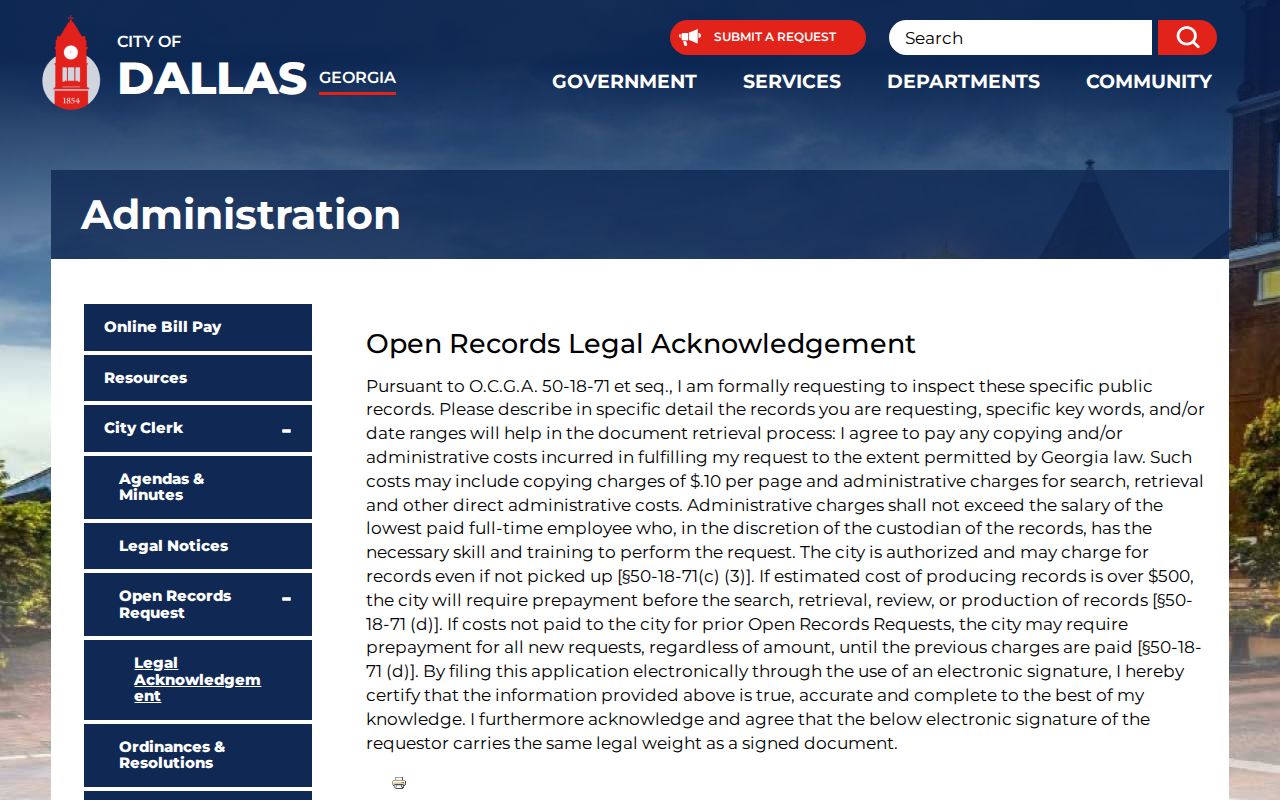
Clear keywords and dates reduce avoidable search work and help Dallas route the request to the right custodian.
Key access laws:
Georgia Open Records Act provides access to public records while allowing statutory exemptions.
O.C.G.A. §35-3-34 governs dissemination of Georgia criminal-history information.
O.C.G.A. §35-3-37 governs eligible record restriction and related handling.