
Criminal Court Cases in Paulding County
Paulding County Superior Court hears felonies, indictments, probation revocations, and other criminal matters within Georgia's general trial jurisdiction. State Court handles misdemeanors and traffic citations. Magistrate Court conducts warrant applications, first appearances, and preliminary work. Dallas and Hiram municipal courts keep their own ordinance and traffic dockets, including some bench-warrant matters. Juvenile Court records follow a confidential framework. A search must start with the court that could hear the charge.
The Clerk of Superior Court maintains the official Superior Court file. Its Judicial Division also provides criminal court records and copies of indictments. State Court case information comes through the clerk serving that court. Case numbers identify a file, but the research does not verify a universal format across these Paulding County courts. Use the number exactly as issued, and pair it with the court name and filing year when asking for a copy.
The Clerk of Superior Court page shows the public office and its role.
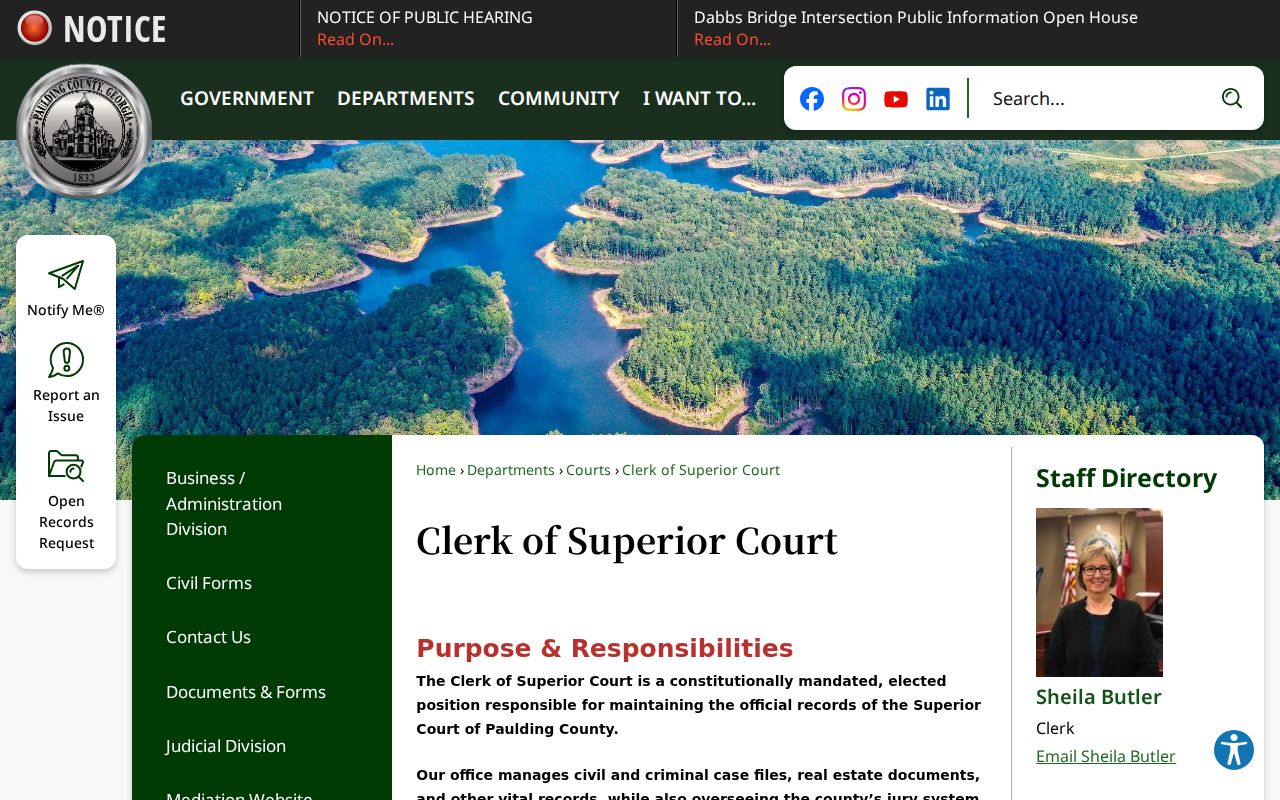
That office is the source for the docket and signed court papers, not the sheriff's booking record.
Paulding Court Jurisdiction by Charge
Georgia does not use one A, B, and C class ladder for every felony. The statute for a charged offense usually gives its range. A felony with no other stated penalty has a baseline of one to five years under O.C.G.A. § 17-10-5, though many crimes have different ranges. Misdemeanors generally carry up to 12 months and a possible fine of up to $1,000. A high and aggravated misdemeanor can carry a fine of up to $5,000, while keeping the 12-month limit.
| Case type | Primary Paulding court | Record to seek |
|---|---|---|
| Felony | Superior Court | Indictment or accusation, docket, plea or verdict, sentence |
| Misdemeanor | State Court | Accusation, hearing entries, disposition, sentence |
| Traffic or ordinance | State or municipal court | Citation, calendar entries, judgment, payment record |
| Warrant or first appearance | Magistrate Court | Application, warrant, bond or preliminary-hearing record when public |
The filed charge controls the route. A booking label may change when the prosecutor files an accusation or seeks an indictment, so the court file should settle the classification and outcome.
Paulding County Case Record Searches
Paulding County's official CASE SEARCH route sends criminal users to the separate clerk site. The clerk interface could not be reliably inspected during research. Its precise fields, date coverage, wildcard rules, result columns, and document-image access are therefore unverified. Do not assume an empty online result means no file exists. The local counter and telephone channels remain the sound fallback.
- Decide whether the matter is a Superior Court felony, State Court misdemeanor or traffic case, or a city citation.
- Gather the exact name, spelling variants, filing year, court, and case or citation number when known.
- Use the county route to the clerk search. Review court, status, filing date, charges, and each separate count.
- Read docket events in order. A calendar or hearing entry shows scheduling, not a final result.
- Call or visit the proper clerk for the signed disposition, sentence, or a certified copy, especially when an image is absent.
| Search detail | Type | Verified requirement | Use |
|---|---|---|---|
| Party name | Text | Not published | Start with the exact name and try lawful spelling variants |
| Case number | Text | Not published | Best identifier for a known Paulding County court file |
| Court or division | Selection or routing choice | Not published | Separates Superior, State, and municipal matters |
| Filing year or date | Date filter | Not published | Helps narrow common names if the live system supports it |
These are practical search details, not claimed labels from the live interface. Georgia's Judicial Council also maintains an E-Access to Court Records directory. It routes users to participating providers, may require an account, and is not one complete free statewide trial-court database.
Paulding Criminal Files at Room 1023
The Paulding County Judicial Building puts the main clerk counter at 280 Constitution Boulevard, Room 1023, Dallas, Georgia 30132. The office lists weekday hours from 8:00 a.m. to 5:00 p.m. and telephone 770-443-7527. The Judicial Division's direct information line is 770-443-7529. Ask that division about criminal indictments and court-record copies. A person needing State Court misdemeanor or traffic information may also use the clerk number; the county State Court page displays 678-383-3333 for case-site help.
Paulding County Clerk
280 Constitution Boulevard, Room 1023
Dallas, GA 30132
770-443-7527
Monday through Friday, 8:00 a.m. to 5:00 p.m.
The Judicial Division describes public access to criminal records and indictments.
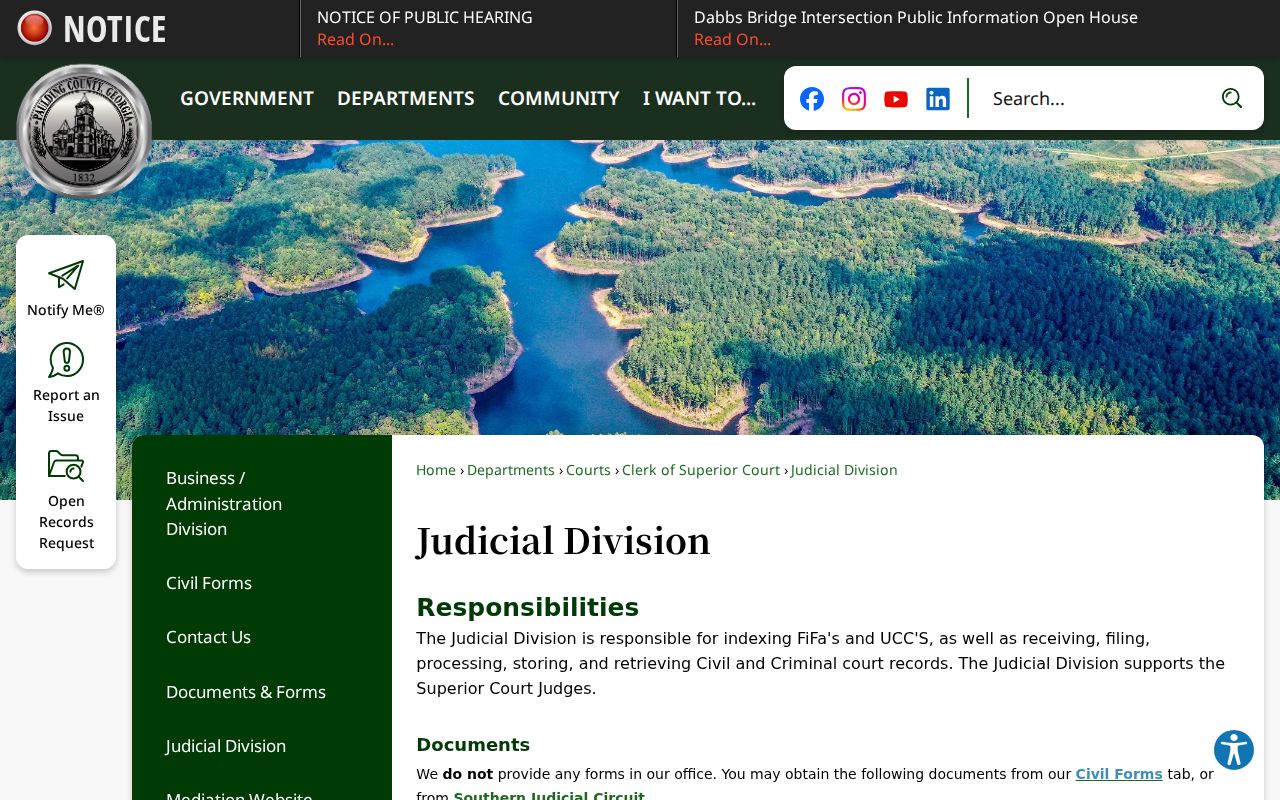
Its direct route is useful when an online index lists a case but does not expose the needed document.
What a Criminal Case File Contains
A criminal file records what the prosecutor filed and what the court did. The header ties the record to a court, case number, filing date, judge or division, case type, and status. Each count must then be read on its own. One may be dismissed while another ends in a plea. Financial entries can also be separate from the sentence and may include fines, costs, restitution, or bond information.
| Case Number & Court | Identifies the court file and distinguishes Superior, State, Magistrate, or municipal jurisdiction. |
|---|---|
| Charging Document | An indictment or accusation states the filed counts and cited Georgia code sections. |
| Docket Entries | Track arraignment, motions, hearings, pleas, trial events, warrants, and later revocation work. |
| Hearing Dates | Show scheduled proceedings; a calendar listing alone does not prove what happened. |
| Disposition & Judgment | Gives the count-specific result, such as conviction, dismissal, nolle prosequi, acquittal, or dead docket. |
| Sentence & Conditions | Records confinement, probation, fines, restitution, and other terms imposed by the judge. |
Public indexes do not guarantee free images. For a result that will be relied on to understand a case, request the signed disposition or certified copy. Protected identifiers, victim data, juvenile material, and records restricted by law or order may not appear in the public view.
Paulding Court Calendars Are Not Outcomes
Paulding State Court publishes live calendars with labels such as criminal arraignment, traffic arraignment, status hearing, pretrial compliance, bond forfeiture hearing, plea calendar, motion calendar, and citation calendar. These entries can help locate the next event or understand the docket sequence. They cannot replace a judgment. A plea calendar does not prove a plea occurred, and a bond-forfeiture hearing does not state its result.
The court system expanded from one State Court judge in 2024 to two in amended 2025 and proposed 2026 staffing. A second judge was sworn in during February 2025, and staffing rose from six to eight positions in county budget material. That growth helps explain more local calendar activity, but it does not change the need to read the filed order.
Criminal Case Stages in Paulding County
The record starts to separate from the arrest file when a prosecutor chooses what to charge. Misdemeanors often proceed by accusation. A felony may go before a grand jury for indictment. Arraignment records the plea. Motions and discovery follow, then a negotiated plea or trial. The disposition resolves each count, and sentencing sets the court's terms. Appeals and probation-revocation proceedings can add later entries.
Case flow: Charges Filed › Arraignment › Pretrial › Plea or Trial › Disposition › Sentencing
The arresting agency and jail keep their own reports and booking entries. Readers tracing the event from custody to prosecution can compare the filed court record with the Paulding County arrest search channels, while treating the clerk's final order as the outcome source.
Paulding Specialty Court Docket Events
The Paulding Judicial Circuit Drug Court began in 2016. County material describes a state-certified program lasting 18 to 24 months for high-risk, high-need people with substance-use disorders facing felony charges. Its five phases can generate treatment, review, testing, and Friday court entries. Unsuccessful termination may lead to revocation or prison exposure. Those entries remain part of the underlying felony file. Drug Court participation is not a separate conviction.
Mental Health Court began in 2019 and is described as an 18-month alternative with outpatient counseling, medical follow-up, testing, home visits, curfew monitoring, and compliance hearings. A docket may therefore show repeated compliance events that reflect program supervision. Read them with the original charge and disposition, not as new offenses.
The Paulding State Court page confirms its misdemeanor and traffic role.
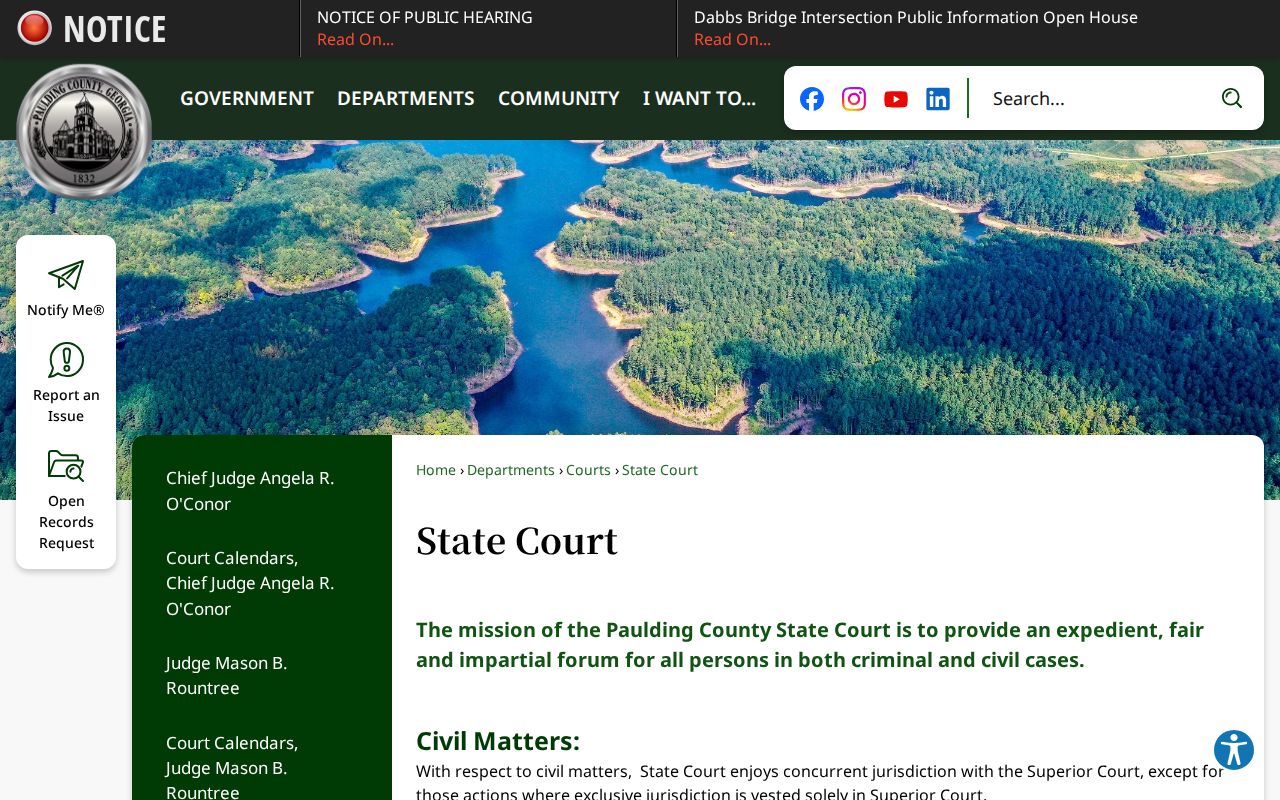
This court's file is the right local source when a misdemeanor charge does not belong in Superior Court.
Federal Paulding Cases Go to Rome
A federal criminal case tied to Paulding County is not filed in the county Judicial Building. Paulding lies in the Rome Division of the U.S. District Court for the Northern District of Georgia. Federal dockets and filed papers are searched through PACER, which requires registration and may charge under its current fee schedule. County clerk and jail tools do not replace the federal docket.
The Northern District's Rome Division page identifies the federal courthouse and clerk access.
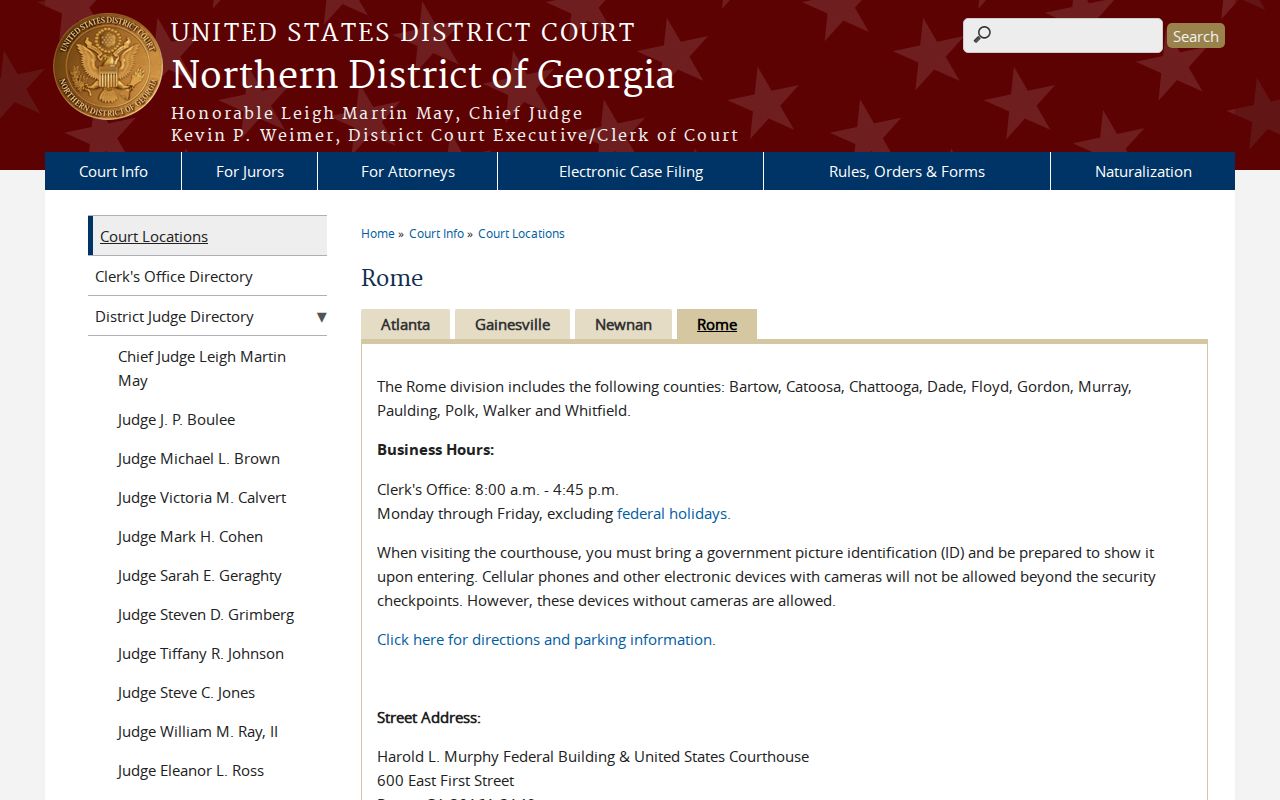
The federal clerk is in Rome, while a Georgia state felony from Paulding remains with Superior Court in Dallas.
Access Rules for Case Records
Georgia court records begin with a presumption of access, but public does not mean every field or file is exposed online. Uniform Superior Court Rule 21 allows a judge to limit access through a tailored order that identifies the affected material, reason, and duration. Juvenile cases, protected victim information, personal identifiers, and some sealed or restricted matters can be withheld or redacted. Active law-enforcement records also follow different rules from filed court papers.
Access point: The Georgia Open Records Act governs agency records, while Rule 21 and court law govern access to the clerk's case file.
Georgia record restriction under O.C.G.A. § 35-3-37 limits qualifying GCIC dissemination. It does not automatically erase the clerk's papers. Court-file sealing is a distinct request. When a Paulding County case does not appear online, ask the clerk about archive retrieval, restricted access, or a paper record. Absence from the index does not establish that no case exists.